
My complete StoryMap which I started before I left for Japan is here. If you want to see what else I got up to while I was in Japan, feel free to check it out!
Final Blog Post: On Site Cross Cultural Reflection
For my final post, I will be writing a reflection on the study abroad cpntract I made before I left, as well as key moments I experienced relating to cultural learning.

Academic development was an area where I think I completed only about 33% percent of my goals. While I am happy to report I did attend all of my language courses ( I took lots of vitamin c to make sure I did not get sick) there were instances where I did speak in English, and I did not participate in the JLPT in December. To be honest, I thought I would be more disappointed in myself, for only completing a fraction of my goals, but in retrospect, I may have been slightly too ambitious. For instance, watching movies and dramas only on Japanese is a skill we are only just now starting to focus on in my 400 level Japanese class. Also, I did not check the date for the JLPT before making this, but if I had I would have seen that I would be leaving the country before the exam took place.
Upon further reflection, I think the goals that I had at the beginning of the program would not have made me happy while I was studying abroad. To achieve said goals I would have more than likely had to dedicate a significant portion of my time towards studying, and I would have felt like I was lacking in feel like I was experiencing the culture of Japan. It is true in hindsight that I went on study abroad to further my language skills, but having grown as a person, I can understand how language acquisition is only a small part of the study abroad experience, and other things should not be ignored in favor of studying. Overall, I think I did a really good job speaking Japanese whenever I could, and I am so thankful for having roommates who spoke (really good) Japanese and wanted me to push myself, despite English ending up as the default language I spoke among my other friends.

The global awareness section is where I would like to make the most amendments. About a month into my study abroad I got the opportunity to volunteer at a nursing home through one of my professors. The volunteer experience was significant for vital in understanding how Japan is preparing itself for an older population. If you are not aware, in recent years Japan’s population increase has stagnated, and as a result, there are now more elderly people living in the country than there are people in the younger generations. This is due to a combination of factors such as; an overall increase in the cost of living, and the younger generations waiting a longer period of time before getting married. Through my volunteer experience, I was able to see how both the private and public sectors of Japanese society were responding to this issue. Also, to spending time with some of the residents, I was given the amazing opportunity to see the entire facility.
In many ways, I feel like America can learn how to better support our own aging community, by looking at countries such as Japan as an example. The facility I visited, was unique in the sense, the clients/patients who used the service, either stayed there full time or were brought to and from the facility each day by a service. This is something I hope America can adapt somewhere in the future, as I know having facilities that offered this kind of service would have been helpful for when my grandmother lived with us (as far as I know the only services offered where I live, would have required my grandmother to move in indefinitely, and at a very high cost).
I think this experience goes to show, while you may be expecting to have one kind of experience while you study abroad, more often than not, the experience you have will be drastically different. Not to say that that it is a worse experience, but just different. This would tie back into being a better global citizen, as it would allow a person to demonstrate increased flexibility and comfortability with adapting. These are very important traits to have not only for job hunting but for interacting with others as our world becomes increasingly globalized. Before I left for exchange, I was the kind of person who made a plan and stuck with it. If there were any deviations I would honestly feel anxious. By studying abroad and having a unique volunteer experience, I’m proud to say I think I have grown more as a person and become a better global citizen by taking on said traits.

The personal growth section is where I feel like I excelled the most. Not only did I successfully planned trips to Shirakawa-go, and Korankei gorge for myself, I helped my friends plan their trips as well. The process was surprisingly easy, as most of the sites I used to book buses used English, but there were a few times I had to ask help from natives as well. For my circumstances, the bus pass did not work out ( once I started school, I did not have any times where I had 3 to 5 days off consecutively) but I did buy my own ic card and Totoro holder. Furthermore, despite booking my trips solo, I was able to make friends and meaningful connections with neighbors on the bus as well. One of my most proud moments, was when one of my friends told me, he admired me for having the confidence to take solo trips, and I definitely intend to keep up that practice here in America.
However, I think my most powerful moment of culture learning came when I had the chance to st with my roommates around our dining room table and just talk. I was able to share with them all my insecurities about learning Japanese, and they shared their frustrations with learning English as well. This made me feel a lot better and secure about my language ability, while also giving me the confidence to feel as if I can achieve my language learning goals. I have posted a blog previously about my language journey, but after studying abroad I feel as if I can look at continuing my language journey in a very different (ie more positive) light. I know I have the confidence to continue to improve myself, both with my language goals and just as a person, because I have the world’s greats and most loving people supporting me. And I wouldn’t change that for the world.
Final Journal Entry: What Comes After Exchange

It has now been a little over 3 months since I have returned from my study abroad experience in Japan. In addition to transitioning back to American life, I have been kept busy with transitioning back into American university life as well, as I complete my last semester of college. As much as I would like to think my transition has been seamless, I can remember distinct instances where culture shock had an intense effect on me, and when difficulty coming to terms with my (amazing) study abroad ending in general. Looking back on said instances, here is a list of notes I hope others in my situation can use to make their transition easier, and know they are not alone.
- Remember to be kind to yourself. Understanding you have just gone through an amazing transformation of sorts, and understanding how your identity has been challenged and changed by your study abroad experience is important. I felt like I was drastically different from the person that had left by herself to Japan just 4 months prior, but I didn’t necessarily want others to know that, or that I was struggling. In my case, I don’t think I was giving myself enough of an allowance to feel sad and properly digest how I had changed. Likewise, but albeit probably more insignificantly, I was frustrated. A lot. I was frustrated I had to go back “home” and leave my friends, I was frustrated despite taking efforts to extend my study abroad while I was in Japan it didn’t work out, and I was frustrated the conveniences I had gotten used to (like taking public transportation, and being able to walk down the street to the drug store to get my favorite jelly snacks) no longer existed. Feeling frustrated is to be expected, and is often talked about, but what you should do about that frustration I feel like is only talked about to a lesser degree. Here are some of my solutions.
—-Connect with others who have similar feelings. Saying this bluntly, my message chatroom with my friends is full of messages of self-pity and wallowing in our sadness. But this group chat became such an important lifeline for me, because it made me feel not alone.
—-Take steps to reconnect with your host country. The MSA book suggest this tactic as well, by finding communities within your area you can join, but I have found the most important method for me, was visiting a large Japanese supermarket in my area, and splurging on snacks that I had enjoyed during my study abroad. Despite not being able to find everything I wanted (I am still on the hunt for the elusive Calbee jagariko potato snack) just being around an area where I could reconnect to my experiences in Japan was helpful.
- Remember this is not the end. As dramatic as this may seem, as I was leaving, I was struggling a lot with feelings of helplessness and panic. The community of amazing friends, teachers, and peers I had built for myself felt almost like it was being stolen from me, and I would never again experience the same kind of happiness I had felt during my study abroad. To make matters worse, due to past study abroad experiences where I had this happen, I was afraid my friends and I would gradually lose touch over time. This does not have to happen. Before I left Japan. I made a promise to myself I would not lose touch with my friends. Even when I find it hard, because they don’t always message me back, I send at least one message a week to each of them. Likewise, before leaving, some of my friends staying behind in Japan gave me letters, I have been making it a priority to make sure each person who gave me a letter, gets one sent back in return (even though mailing is super expensive). In addition, attending my re-entry dinner (organized by my school) helped ,e out as we were able to talk with people who had studied abroad in the past, and hear how they were still in contact with their study abroad friends (my study abroad director just had a reunion with her friends who she met in Switzerland over 20 years ago!) Using tools and methods such as this has helped me not feel so afraid and lonely anymore.
There are a lot of emotions you will feel as you complete your study abroad experience. Whether you only stayed for one semester, or for a full year, the relationships and memories you have made will change you in ways that are difficult to articulate unless you have experienced this yourself. Before coming, and right after you return, you may find yourself feeling a variety of different emotions, but by giving yourself time and uses some of the strategies I have talked about above, the feeling will go away, leaving you with an unforgettable experience you can talk about and remember fondly for a lifetime.
Dealing with Disappointment: My Language Struggles (In Country Journal 2)
To be frank, my Japanese language learning journy has been long and arduous. It is no wonder the Foreign Service Insitute ranks Japanese as a category 5 or “super-hard” language, estimating a minumum of 2200 to reach fluency. I first began learning in the summer right after I graduated from high school, by participating in a brief 5 week study abroad program. From that point I have taken formal class through my college, retaken classes, and even given up in frustration as well. During said periods of giving up, I have repeatedly asked myself if it was worth the countless hours of studing and frustration to achieve the (very) broken proficiency I have gained thus far. And the short answer is; yes.
According to the American Association of Teachers of Japanese, have this to say about those who choose to embark on the long journey of mastering Japanese, “You possess determination, patience, and absolutely no fear of challenging yourself. The majority of people who learn a foreign language choose a European language like Spanish, French, German, or Italian, because it is familiar. You can show that you have a multicultural perspective that goes beyond the familiar”. Whenever I feel like I have hit a wall or been disapointed in my Japanese learning journey I like to look back on this quote to remind myself of why I first decided to begin studying Japanese, and what I think I can offer to the world. Lately, I have been looking at this quote a lot, as I deal with dssapointments while abroad.
Taking the Japanese proficency test at NGU was quite the experience. The entire test lasted about three and a half hours with the test broken into three sections; computer testing ( which measured grammar,kanji, and listening apptitude), an interview, and a written essay. There were no breaks inbetween the sections. Despite having completed the 300 level Japanese courses at my school, I struggled with the grammar questions. Likewise, the listening became incresingly complex and difficult to undershand. My friend described it perfectly when she said it sounded a lot like trying to have a conversation with someone while riding the subway. In addition, while I understood Japanese has a specific form to use when writing essays,which is different to speaking the language, I panicked at having to write Kanji. To put the cherry on the cake, the school had a week-long break, and I spent that tweek anxiously awaiting my placement results.
In the end I was placed in the 200 level equivalent. I have to admit, I was disapointed at first, but in an attempt to look towards the brightside, I decided it was better to fix any holes or gaps I have now, in order to strengthen my foundation. However, despite me learning this material at some point, most of it I have forgotten, which has led to some issue or another. The course itself is very rigorous, and it’s frustrating when I don’t see the effort I am putting in reflected in my grades. Further, seeing my fellow classmates not struggling with the material, makes me feel poorly about myself and my abilities.
Nevertheless, throughout this entire process I have had unrelenting support from my roomates as well as my classmates. I recently had the opportunity to sit down with a teacher well aqquainted with my college back home to voice some of my frustrations. He paitently sat through everything I wanted to get off my chest and gave me some advice I thought I would share with others going through a similar harship during their language study. He said, “The person you are now should only be compared to the person who you were before. When we become stuck thinking there can only be winners or losers, we become rigid in thinking and fail to move forwards. You can still learn from failure”. I hope to keep these three wisdoms in mind moving forwards in my study abroad experience, and hope that I can one day grow into the kind of person which can embrace frustration with this kind of positive thinking from the get-go. Moreover, I hope whoever reads this post, whether they have any language frustrations or not, learns how to as well.
A Very Late Check In (In Country Journal #1)
It has been a little under a month since I have arrived in Japan. As cliche as it may sound, it does really feel as if I have only arrived yesterday, and my trip is still not yet almost 1/4 of the way over. Let me try my best to get everyone up to speed.
I left America on Sunday, September 2nd, and arrived at Narita Airport in Chiba Prefecture. Some of you may remember me previously stating my program was to be held in Nagoya Prefecture, so you may be a little confused as to why I arrived no where close to Nagoya, and at a completely different airport that what was indicated in my story map. The reason is, I went a little under a week early in order to explore Tokyo with a friend who is currently studying at a different program in Chiba. We were able to see many different places including; The Studio Ghibli Museum,


By now, you can probaly already tell, I’m quite a big Ghibli fan, so being able to visit the museum was a special trip for me. Although buying the tickets through lawson was a painful experience, I was able to fulfill a lifelong dream of mine. The next place I visited was the top of the Tokyo Metropolitan Government Building.

I have to give my friend major props for finding this location. , as it has the same height as the more commonly visited Tokyo Skytree or Tokyo Tower, but there was no admisson cost. While we did hav to wait about a half hour in line to get to the top, the views definetely made it worth it. After that we visited the Teamlab Borderless Digital Art Museum in Odaiba.


This experience was less about the tradition culture and beauty of Japan, and more of a glimpse into what sort of modern technology is being developed. Japan is a great country not only for it’s traditional hertigages, but also the modern advances it is contributing as well. But who am I kidding, I mainly wanted cute instagram photos. I had seen photos other tourists had taken at this location before, but they still didn’t prepare me for the beauty and awe of experiemcing a place like this first hand. For those of you who don’t know, this location is basically a huge colorful playground for both children and adults. Rooms are dedicated to different themes and activities, such as the butterfly/flower room, and the under the sea, nature activity park.We were only able to spend about two hours at this location (and thus couldn’t see every room) and the price was a little steep at about $30.00 USD, but I would honestly go back to spend more time exploring. A tip for anyone who is interested in going in the future, wear light colored clothes, the patterns and lights will show up much better! The last experince I want to share, was the Chofun Fireworks Festival.

Despite being packed in a train and a bus like a sardine in a can, I can honestly say the experience was better than any firworks festival I have attended back in my home country. There were distinct differences, such as the sheer mount of people who attended ( I swear there had to be at least 10,00 people there) to the way the fireworks were shot off and how long the performance was. It was breathtakingly beautiful, and left me with an ache which lasted for days afterwards. If anyone has the chance to visit Japan in the summertime, watching a fireworks festival is for sure a must.
The following day I left on a night bus for Nagoya ( In the middle of a typhoon might I add) and arrived the next day where the next part of my journey began.
Place I Would Like to Visit: Gujo Hachiman
Tucked away in the mountains of Gifu prefecture is a town know as Gujo Hachiman. Known as the Water city, Gujo Hachiman is famous for it’s pristine water ways. In addition, it is also called the fake food capital of Japan as many of the displays in front of restaurants show fake food of what is offered inside, called sampuru..
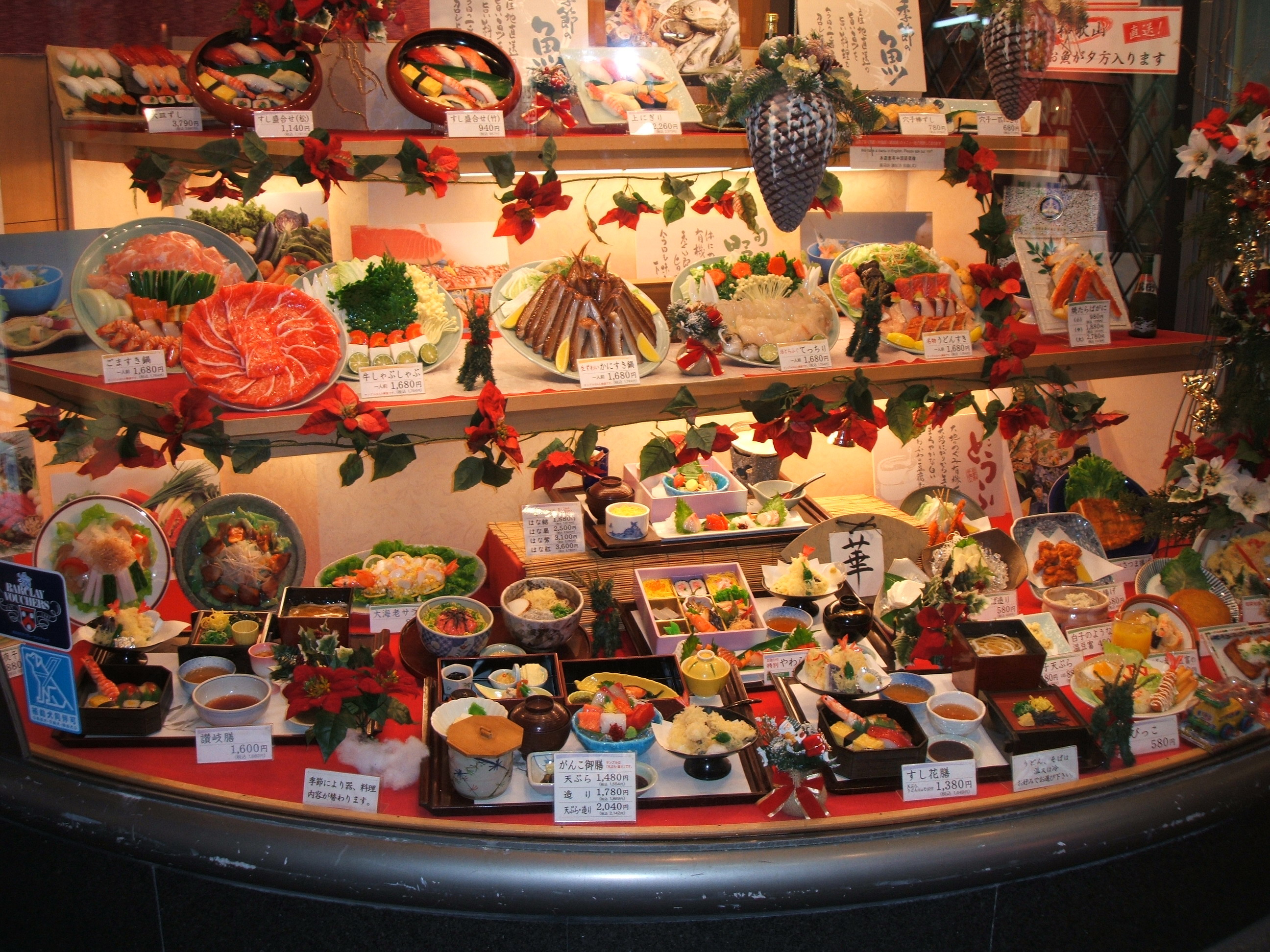
This is what a typical display of fake food looks like outside a restaurant. Looks real doesn’t it?
I’ve seen a lot of increased interest surrounding this town in the recent years, and I thought it would serve as a nice day trip I could try use to ease myself into solo traveling.
There are three rivers which flow through the Gujo Hachiman district: the Nagara-gawa, Yshida-gawa, and Kodara- gawa. Kawa, in Japanese, is the suffix used for river and the Chinese character or kanji, looks like this, 川. I am not sure if it because I am very familiar with the kanji, but it has always looked like a picture of a river to me! According to niponica, a web magazine specializing in introducing parts of Japan to the world, there are 107 natural springs which are used for various purposes around the city. The concept is called a “mizu-fune” or water boat, and are unique to Gujo-Hachiman.

Spring water is collected in the upper level for drinking water and in the lower level for wash and keep vegetables
In a previous post, I mentioned a natural conservation method Japan uses in order to maintain balance between humans and nature called Satoyama. From the research I have done, it appears Gujo Hachiman would constitute one such environment. The water in used in such a way that benefits both the local town, and maintained for the natural landscape as well. Taken from the official Gujo Hachiman Town Tourism Association website, Gujo Hachiman is, “know throughout Japan for it’s pristine water, and ecological practices to maintain the environment”. While on the website it does not mention specifically what practices are used beyond general few, it gives me the opportunity to go and ask in person!
In addition to the water ways, I am excited to see the castle, which was reconstructed in wood, rather than the typical concrete you can see on other castles around Japan. Around November, a festival is held at the castle called the Momoji festival. Kouyou, or紅葉, refers to the tradition of viewing the leaves changing color in the autumn and is considered an important time in Japan. This is a long standing tradition tracing back to the Heian era through various literature.The castle reportedly has a spectacular showing with the colors lit up by spotlights at night. In addition, I have seen many recommendations for the Otaki limestone caves, which includes an underground waterfall!In addition to the water ways, I am excited to see the castle, which was reconstructed in wood, rather than the typical concrete you can see on other castles around Japan. Around november, a festival is heald at the castle called the Momoji festival. Kuoyou, or In addition, I have seen many recommendations for the Otaki limestone caves, which includes an underground water fall!
Letter to Self
One of my goals of study broad is to not have any regrets. I have had the opportunity to experience a few other study abroad experiences, but each time I finished I could never quite shake the feeling there was something that I still had left to do. I understand this is a part of the study abroad experience, and I may never get to a point to where I am completely satisfied (because I’m not even sure that place exists, or is possible to reach). Part of the reason I decided to name this blog koukainashi, is because in Japanese it means no regrets (or at least I think it does, roughly). My hope is to be able to use my past experiences to have the best experience I possibly can while I’m in Japan. That being said, I’m going to approach my experience as one where if I get all of my so-called “goals” accomplished then great, if not, then I’m not going to worry about it. That being said, here is a list of what I hope to accomplish while I am in Japan.
- Gain a better sense of self. This is something I think I have been able to accomplish every single time I have study abroad in the past. The act of studying abroad forces you to understand yourself, and your surroundings better, by putting you in situations you would otherwise not experience in your host culture. Each time I have went abroad I feel as if I brought so much more personally than what I left with. I can’t wait to see what I discover this time around.
- Gain clarity about my future. Lately I have been entertaining the idea of completing my masters in Japan through the government sponsored scholarship MEXT. I would be studying at a Japanese university, with classes taught entirely in Japanese, along side other students. Studying abroad with provide valuable insight into what the education system is like, and whether I think it will be a good fit for myself in the future.
- Creating connections. Something I have regretted not doing in the past, is not making enough connections and friendships with nationals while studying abroad. As I have grown older I have realized how important it is to create a support system for yourself with people who challenge who you are as a person. By expanding my network to include others from all over the world, not only will I never be lonely wherever I may end up, but I will become change for the better along with y support system.
- Eat all the food. I mean, do I need to say more? 🙂
Historical Event: Summer 1964 Olympics
One of the most anticipated events coming to Tokyo in 2020 is the summer Olympics. Historically, Tokyo has only hosted the Summer Olympics on one other occasion; in 1964. Attending the Tokyo 2020 Olympics is something I am seriously considering, so looking into Japan;s past hosting the even became the the main topic of this weeks blog post.

According to multiple sources, Tokyo was slotted to host the Olympics in 1940, but due to their invasion into China, later relinquished that right. After World War II, Japan faced a bleak economic outlook, and was initially denied their first bid for the 1960 Olympics. After persisting, Japan won their bid for the 1964 games, symbolizing a re-acceptance into the world community and, “the end of a long bleak period for many Japanese”. However, reportedly there was major discourse concerning whether Japan would be able to complete the necessary preparations to host the games.

After being awarded the Olympics, a series of major development projects were undertaken which included; new highways, sports venues, hotels, airports and railway lines. However, perhaps the most well known was the construction of the Tokaido Shinkansen, or bullet train, connecting Tokyo and Osaka. There were societal changes as well, as Japan saw an increase in popularity of sports clubs and training centers for citizens of any age, which the legacy of can still be seen to this day.

While researching its seems as if some historians are of the opinion hosting the 1964 Olympics were a guise to rehabilitation of classical national symbols. In this way, the Olympics became a significant political game for Japan as well. The ultimate goal being to restore national pride and faith in the emperor, while painting themselves as a symbol of peace. Faith as to be restored in the empower by bypassing the first article on the new Japanese Constitution; ” “the Emperor shall be the symbol of the State and of the unity of the people.” What is significant about this fact, lies in the fact the emperor could not legally make the official proclamation traditionally held at the beginning of the games, without overstepping the boundaries put forth by the first article. Instead, the Organizing Committee and the Ministry of education gave him the title “Patron of the Tokyo Olympics” which allowed him to make the proclamation, as well as squash any public speculation over the emperor’s status, and whether he truly remained the head of the nation. Comparisons were made between the bids for the 1964 and 2020 Olympics, with some historians claiming the 2020 bid is problematic for its attempt to revive the atmosphere of the 1964 games, and as a result it’s nationalistic spirit.

In the article Tokyo – Bidding for the Olympics and the Discrepancies of Nationalism by Satoshi Shimizu, Shimizu calls attention to the bidding process, and Japan’s role after failing to secure the 2016 bid as well as the impact it had on Japan’s politics. It seems the Olympics may have played some hand in the Liberal Democratic Party taking control of the nation’s affairs from the Democratic Party in 2012. Shimizu later goes on to state, ” the sporting world of Japan is strongly influenced by people with intentions”, using the manipulation of the Basic Act on Sport as evidence. The act was adjusted to make Tokyo more appealing as a candidate, but is seen more as manipulation at the hands of bureaucracy instead of a serious demand from the Japanese citizens. In this way one could argue Japan is taking a page from its nationalistic past, choosing to create another political game by means of the 2020 games. This argument gains more support, given Prime Minister Abe being open about using the games as a way to make Japan a lead actor in international relations, as quoted in the article.
An interesting counter argument to this viewpoint I came across was from a BBC radio interview with Paul Droubie, who serves as an expert in the 1964 Tokyo Olympics. He is of the opinion the differences between the games are actually much larger than the similarities. The previous bid was mainly made to help support much needed urban development, and issue the Tokyo of today no longer suffers from. He doesn’t deny the 1964 were mainly motivated for political reasons, but Japan no longer is in the same position before, when casting bids for political reasons was the driving force behind hosting the Olympics.
Attending the Olympics has been a long standing item from my bucket list. As the summer of 2020 quickly approaches, it seems like like my goal may finally be actualized. It will be interesting the changes Japan makes as it prepares for the games, and I will be able to witness some of them firsthand. Likewise I am interesting in learning what sort of opinions Japanese citizens have about them hosting the Olympics and if they have anything to add to the ongoing discussion.
Japan’s Government
At first glance, the set up of the Japanese government seems entirely different when compared to my home countries. In a previous post, I mentioned instead of a President, Japan has a Emperor, and a prime Minister as well . In this week’s blog post, I was tasked with researching the government structure of Japan, as well as any current legislation or political debate. So here is my very short introduction to the Japanese government.

The Minster is addressing the two Houses
All rights go to Wikicommons, the photo was not altered in any way, and no money is being made from this blogpost
According to the CIA fact book, Japan’s government system can be defined as a parliamentary constitutional monarchy. This means in the legislative branch runs under a bicameral National Diet. The Diet is composed of two houses, the House of Representatives and the House of Councillors, and are in charge of not only passing laws, but for selecting the Prime Minister as well. In total, the Diet has 707 seats, 242 from the House of Councillors and 465 from the House of Representatives. In the executive branch, Emperor Naruhito, who just recently assumed the throne, is listed as the current chief of state, and the head of government is Prime Minister Shinzo Abe, who was elected in 2012. The monarchy is hereditary while the leader of the majority party, or the majority coalition in the House of Representatives typically becomes the Prime Minister. However, such a system was not always in existence, and saw massive reforms after World War II.
Prior to World War II, the political structure was inherited from the Meiji era, and was increasingly dominated by the military. In addition, the ideology became focused on the emperor as the head of the main religion of Shinto (this is different from the Shintoism of today and is referred to as National Shintoism) who was believed to have descended from gods. Further, patriotism “had been raised to the unassailable level of sacredness”. It was not uncommon for extreme sacrifices to be made in the name of the emperor. After Japan surrendered in 1945, the government was promulgated and a new constitution was instilled according to General Douglas MacArthur, an American. At this point, the Japanese Army was dismantled, and officers were banned from taking roles of political leadership. Also, the emperor’s status was downgraded to “that of a figure head without political control”. The reason for the changes given was to ” place more power in the parliamentary system, promote greater rights and privileges for women, and renounce the right to wage war, which involved eliminating all non-defensive armed forces”.
Currently, the constitution consolidates the principle of autonomy for local public entities. This was major change from Japan’s mainly feudal past, where the pheasants were not allowed autonomy and worked for daimyos, or vassals of the shogun. Moreover, many of the descisions which effect day to day life pertaining to labor, education, social welfare, and health—as well as land preservation and development, disaster prevention, and pollution control—are dealt with by local governing bodies. Japan is divided in 47 prefectures, which vary greatly in size and population, are governed by assemblies and governors. Additionally, the prefectures are divided further into wards and other minor civil divisions with a designated mayor elected by the residents.
The last time I was in Japan, I witnessed a demonstration in one of the main roads of Kyoto. Bring my curious self, I looked at the banners to try and figure out what the protest was about. The protesters were calling for the elimination of the American military bases in Okinawa, Japan’s southernmost island. After World War II, and American naval bases were set during the occupation, and now Okinawa is the home to 70% of American military personnel stationed in Japan.. The image of the protesters has always stuck with me, and I used this assignment to research why such a sentiment exists. While researching I found out crime was a major problem in relation towards American military personnel, especially in regards of violence towards women. While reading the article, Not A “Yankees-Go-Home” Solution to the Sexual Violence of the U.S. Military, it seems while the acts of violence are shocking within themselves, the lack of response in part of the American military have left many Okinawans frustrated. Such acts are not only disgusting, but it also threatens the U.S.-Japanese military alliances which plays a key role within Asia. While it seems in this case, the author is not calling for the elimination of American military bases in Japan altogether, one can assume this is one of the reason why such a sentiment exists (and I am sure this just but the tip of the iceberg). This is an issue I hope is addressed some time in the future, given how the author cites both failures on the part of the American military and on the Japanese legislative and judiciary system.

Taken on 24 January 2016
All rights to Hanonimas on wikicommons.
The photo was not altered in any way, and no compensation is being given for this blog post
Adjusting; Pre-Departure Activity
In this weeks journal entry, I read about an in-country culture strategy referred to as adjusting. Learning how to adjust to a new environment and culture is perhaps the most difficult task when preparing to study abroad. According to the book used in this course, and P.K. Bock, an anthropologist and author of many books on the topic of culture, suggests there are three kinds of adjustments one must make when going to a new environment. Those three adjustments are physical, social, and internal adjustments. Likewise, the best way to overcome difficulties associated with cultural adjustments and shock must be flexible, and have the ability to recreate home where ever they may be.
The exercise associated with this lesson asked me to make a list of both potential high and low points I expect to encounter while I will be abroad. This will give me a chance to assign helpful coping strategies, thus enhancing my experience. As I have not yet begun my study abroad program, the goal was to get me to think about what kinds of events I would want and how to realize them, and others I would want to avoid. My list is as follows:


The book suggests, finding someone who understands things from your own cultural perspective or from your host country and talk things over with them. In addition, connecting with friends and family back home is given as a suggestion as well. I was surprised at the former, as I always thought if I were to contact family or friends when I was feeling lonely or vulnerable, it would ultimately have the opposite effect and just make me feel worse, as I wasn’t actually with that person. Perhaps this tip would work well for some but, not for others, and should be carefully considered if it best suites each person’s personality. When talking with my mentor, she suggested doing activities that you enjoyed. Her way to blow off stress or deal with loneliness was to binge watch episodes of Master Chef and Hell’s kitchen (she’s a Gordon Ramsay fan) and thought it was an effective strategy. This strategy also seems as if it could act as a double edged sword, as it could cause some to spiral deeper into feeling bad.
Conclusively, I believe the best method which will work for me, would be repetitive reminders, I can only do so much. This would be helpful in not only checking my expectations and making sure I do not disappoint myself, but I’ve also found success in utilizing this method in other aspects of my life. The book unfortunately, seems to leave this advice out, on pages 99- 100, when explaining surface adjustment and its limitations. While it is true, one go out of their way to make sure they have the degree of contact with host nationals necessary to fulfill cultural adaption requirements, but in a way this seems to be setting people up to feel disappointed. Arguably, that is the last feeling someone should have while studying abroad.
Initially, when I first began investigating study abroad, I wanted to go abroad for two terms, instead of just one (like I am now). However, upon further reflection and introspection, I have come to the conclusion one term may be the best option for me. Adapting and adjusting oneself is mentally taxing, and I know of cases where people have gone home early, because at a point it just simply became too much to handle anymore. Using what I have learned from the book, and from my mentors I feel confident I have the necessary skills and strategies to make sure that is not what happens to me,and I have as much of a fulfilling experience as possible.

